One Entry, Two Trips: How Shenzhen's Hub Reshapes an Itinerary
Why the Second Leg Decides the Trip
By 20 September the border post at Shenzhen Baoan had counted 5.024 million crossings, 5.7 percent ahead of the same point in 2025 and sixteen days faster to the five-million mark. Foreign movements rose 29.9 percent to 1.344 million, and visa-free entries took 65.1 percent of those arrivals, a group growing 42.3 percent.
The route map explains part of it. Baoan now serves 64 international and regional destinations with more than 700 international flights a week, and past thirty APEC-linked corridors carried 3.5 million passengers through August. Surabaya, Tashkent and Kathmandu opened this year, and Sydney joins in December.
None of that is the reason to route a China trip through Shenzhen. The airport matters for what sits within two hours of it: one set of destinations reachable by rail before lunch, another by a short domestic hop. The transfer numbers are covered elsewhere. This is about the second leg.
Half an Hour: Guangzhou, Huizhou, Zhongshan
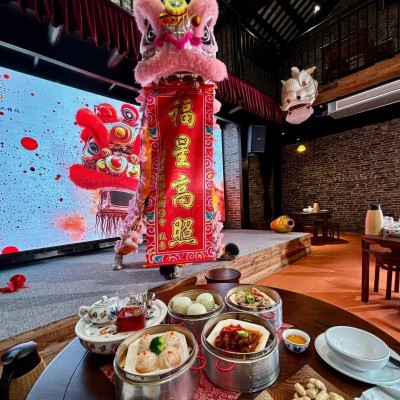
Futian puts Guangzhou East thirty to forty minutes away. That is a commute, and it changes what a day holds: dim sum where the trolleys still rattle past the tables, the restored lanes of Yongqing Fang, the arcades of Shamian as the river lights come on.
Huizhou South is half an hour and feels like another province. Its West Lake carries temples and causeways under banyan shade and stays quieter than the Hangzhou lake it is named for; Luofu Mountain adds waterfalls and a cable car to a Taoist summit. In summer the coast takes over: Xunliao Bay's sand, and egrets over the Yanzhou Island flats at dusk.
Zhongshan runs slower. Cuiheng holds the former residence of Sun Yat-sen, Sunwen West Road keeps a kilometre of century-old arcades, and Qijiang Park turned a shipyard into sculpture. Shiqi squab, roasted to glass-crisp skin, is the dish people come back for.
One to Two Hours: Watchtowers, Then Teochew Kitchens
An hour west, Jiangmen opens onto the Kaiping diaolou: fortified towers raised by returned overseas Chinese a century ago, European facades stacked on Cantonese rooflines, standing in rice paddies. Zili Village and Li Garden are the stops that matter, and Chikan's arcade streets have reopened after restoration. Taishan eel rice and Gujing roast goose fill the afternoon. The sites are scattered across farmland, so a car earns its place here.
Two hours up the coast, Chaozhou and Shantou close the band. Chaozhou keeps a gate street of carved wooden fronts, the Guangji Bridge, and a market that only fills after dark; Shantou answers with temple architecture and the promenade on Nan'ao Island. Beef hotpot cut by grade, oyster omelettes pulled by hand and gongfu tea poured all afternoon are the draw.
Trains run hourly, so the return needs no planning; the eating does, and a coastal Guangdong route beats improvising.
Seventy Minutes to Two and a Half Hours by Air
Past two hours, rail stops competing. Guilin is seventy minutes by air, with the Li River cruise to Yangshuo behind it. Xiamen takes eighty and packs three trips into one: the car-free lanes of Gulangyu, the botanical garden and South Putuo temple, then the tulou roundhouses of Yongding, two hours inland. Changsha is ninety, with the Han tomb collection at the Hunan Museum and the river view from Orange Isle; Hunan recorded 182,300 foreign arrivals in the first half of the year.
Zhangjiajie sits at the same ninety minutes. The Bailong elevator, the glass span over the Grand Canyon and a second day on Tianmen Mountain's cliff walkways carry the trip. Nearly a million inbound visitors came through in eight months, up more than twenty percent, and guest nationalities have widened from single digits to nearly two hundred in five years.
Kunming is the long one at two and a half hours, mild from November onward, with the stone forest outside town and Dali three hours west. Between Kunming and Xiamen, a December-to-February trip has two warm options.
Sequencing: Long Leg First, Short Leg Last
The rule that saves the most trouble: put the long leg at the far end. Fly to Kunming, Guilin or Zhangjiajie early, work back toward the delta, and spend the last two days within half an hour of the airport. A delayed domestic flight on day two costs an afternoon. The same delay on departure morning costs the ticket.
Station choice matters. Futian is the right platform for the Guangzhou intercity, Shenzhen North carries the longer lines west and north, and both beat a taxi at rush hour. Leave the suitcase behind: the airport and the main stations all hold bags, and a wheeled case has no business on a watchtower lane.
The entry rule sets the outer limit. Travellers from 57 countries can use 240-hour visa-free transit, which allows up to ten days inside a designated area with a confirmed onward ticket to a third country, enough for two trips under one stamp. The two policies are not interchangeable, and a semi-self-guided plan is usually where travellers find out which one they qualify for.
Four Habits Before You Book Anything
Four habits cover most of the ground:
- Book the far destination first. Internal flights and long rail legs set the shape; delta days fill in around them.
- Keep the last night close. Half an hour from the terminal beats a scenic send-off.
- Check the exit airport. Arriving in Shenzhen and leaving from Guangzhou Baiyun can remove a backtrack.
- Match the season to the band. Coast and karst in autumn, Yunnan in winter, the delta any month.
Treating Shenzhen as a transit hall with a runway attached wastes the days on either side. The Dapeng fortress, the art district at OCT Loft and the electronics markets fill a first evening and a full day without a train ticket. That side of the city belongs in the plan, not in the gaps between flights.
Frequently Asked Questions
Can I leave Shenzhen for another province on 240-hour visa-free transit?
Yes, within the designated area, for up to ten days. You need a confirmed onward ticket to a third country or region, and you must exit on that leg rather than fly back to where you arrived. Check the permitted area for your arrival port before booking internal flights.
Is Guangzhou worth a day trip, or should I stay overnight?
A day trip works. Futian to Guangzhou East is thirty to forty minutes on the intercity, so an early start covers dim sum, the old lanes and Shamian before an evening train back.
Should I take the train or fly to Zhangjiajie and Guilin?
Fly. Both are seventy to ninety minutes by air, while the rail alternatives eat most of a day. Keep trains for the short western legs, where stations sit in city centres and there is no check-in at either end.
Programmes Built Around a Shenzhen Arrival
- Guangdong Cinematic Trail: From the Knockout Set to UNESCO Diaolou - a filmed-location route that ends among the Kaiping towers, an hour from the delta by rail.
- Chaoshan Food Odyssey: 3 Days in Chaozhou, Shantou and Nan'ao Island - for travellers who want the two-hour band to be the whole point of the trip.
About the Author — Sam · Custom Travel Planner
Sam plans semi-self-guided China trips around fixed flight dates, and spends much of his time deciding which destinations belong at the front of a trip and which can wait until the last two days, when the airport needs to be close.
Route the Trip Around the Flights You Already Have
We build two-part itineraries from a Shenzhen arrival, and we will say plainly when a destination belongs on a different trip - how semi-self-guided planning works →
Email Sam for private itineraries, or Luppy for groups of ten and above.
More Than Travel. It's the Plus That Matters.